
Sales Team Motivation: Why Incentives Alone Won't Move Your Reps
What Clayton Christensen understood about motivation, and how it changes the way you lead a sales team.
 Spencer OuzounianVP of Revenue at Enzy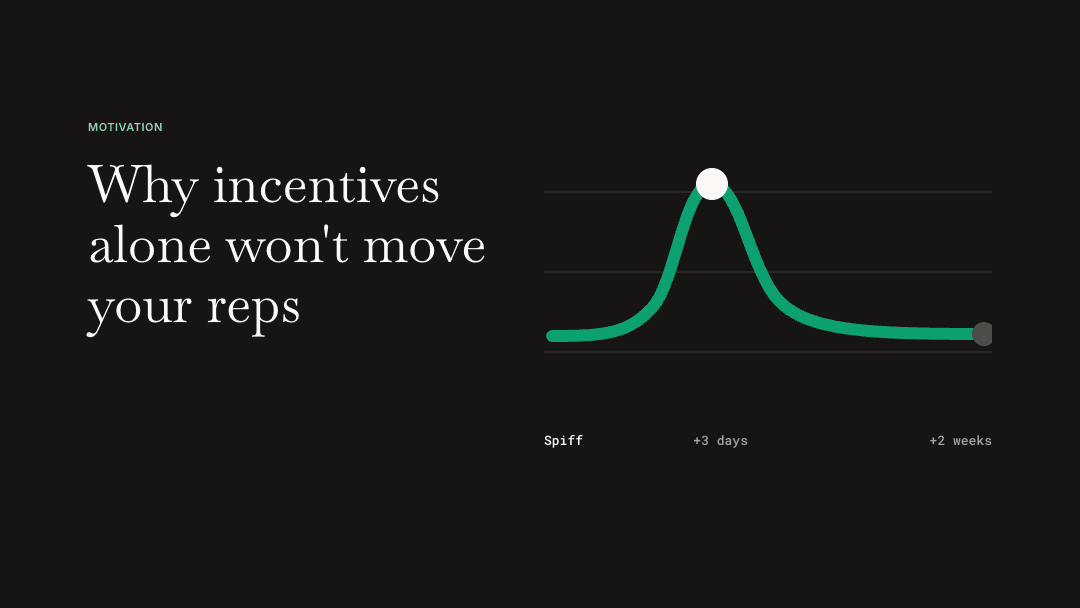
If you have run a field sales team for any length of time, you already know the move. The numbers dip, so you put more money on the board. You raise the commission, you announce a spiff for the weekend, maybe you promise a bonus to whoever knocks the most doors by Friday. And it works, for about a week. The board lights up, a few reps sprint, and then the energy settles right back to where it started.
I have made that move myself more times than I would like to admit. Early on, back when I was managing a door to door team, I wrote a five hundred dollar spiff on the whiteboard in red marker for whoever set the most appointments over a weekend. One of my newer reps took it personally and knocked like the neighborhood owed him money. He won it, we made a big deal out of it on Monday, and by Wednesday he was setting the same number of appointments as everyone else on the team. The cash spiked his effort for about three days and then it was gone, and at the time I honestly could not have told you why. It took me a few years to understand the lesson underneath it: money buys you a short burst, not a motivated team.
That gap between a burst and real drive is the whole game. The short version, if you only take one thing from this piece: sales team motivation comes from recognition, challenging work, ownership, and growth, not from pay alone. Compensation keeps your reps from being unhappy. The drive to compete, push each other, and want to win comes from everything you build around the money.
Why Do Sales Incentives Stop Working?
Incentives are not useless. They are just aimed at the wrong target. When you raise the payout, you are changing the price of a behavior, and people respond to price for a little while. What you are not doing is changing whether the rep actually cares about the work. That is why the spiff fades. You bought a week of effort, and once the money is banked, the reason to keep pushing goes with it.
The question underneath all of this is the one every sales leader is really asking, even when they phrase it as a comp question. It is not “how do I pay my reps to hit the number.” It is “how do I get my team to care, to compete with each other, and to want to win on a Tuesday in February when nobody is watching.” Those are two different problems, and the second one does not have a dollar amount attached to it.
What Clayton Christensen Figured Out About Motivation
In his book How Will You Measure Your Life, Clayton Christensen works through a debate he had with his own students about what actually makes people work hard. His students were convinced that the answer was financial incentives. Christensen argued there was something deeper going on, and he built his case on two competing schools of thought.
The first school comes out of economics, from a widely cited 1970s paper by Michael Jensen and William Meckling on what is often called agency or incentive theory. The idea is straightforward: people work according to how you pay them, so if you want a certain outcome, you align the pay with that outcome. It is clean, it is measurable, and it is the logic behind most sales comp plans in the world.
I will be honest with you, for a long time I lived entirely in that first camp. When a rep was underperforming, my answer was almost always to change the numbers on the comp plan. It worked often enough that I never really questioned it, right up until it stopped working on the people I most wanted to keep.
The second school draws on the work of Frederick Herzberg, and it turns the first one on its head. It accepts that you can pay people to do what you want, over and over. But it draws a hard line between paying someone to act and actually motivating them. As Christensen puts it, “True motivation is getting people to do something because they want to do it.” That kind of drive holds up in good weeks and bad ones, which is exactly what you need from a field team.
Here is the anomaly that made me a believer. Some of the hardest-working people on the planet earn a fraction of what they could in the private sector. Think about people who staff nonprofits in disaster zones, or who serve in the military. Pure incentive theory cannot explain why they push so hard for so little. Something other than the paycheck is driving them, and if you lead salespeople, you want to understand what that something is.
Hygiene Factors Versus Motivators
Herzberg’s answer was that job satisfaction is not one dial that runs from miserable to thrilled. It is two separate scales, which means a rep can genuinely appreciate parts of the job and resent it at the same time. He split the drivers into two groups.
On one side are what he called hygiene factors. These are things like compensation, job security, working conditions, company policy, and the relationship with your manager. Get these wrong and your reps will be dissatisfied. Get them right and you have not created drive, you have simply removed a reason to be unhappy. The compensation plan lives right here. It is a hygiene factor, which was the part that surprised Christensen’s students the most. Fair pay stops your team from being resentful, but it does not, on its own, make anyone love the work.
On the other side are the motivators: recognition, challenging work, responsibility, and personal growth. These are the things that actually make people care. They come from inside the work itself, not from the size of the check.
And the practical upshot for a sales leader is this. If you keep pulling the compensation lever to fix a motivation problem, you are working the wrong side of the equation. You can only ever get a rep to “not dissatisfied” that way. The drive you are looking for lives in the motivators.
Why This Explains the Rep You Cannot Seem to Reach
I lost one of my best closers this way, and it taught me more than most of the wins did. He was making great money, he had a full pipeline, and somewhere along the way the fire just went out of him. He started showing up late to our morning meetings, then skipping them altogether. I did what I always did and put more money in front of him, and it changed nothing, because I had already maxed out the hygiene lever for that guy. He left a few months later for a competitor, for pay that was barely different from what he was already making. On his way out, he told me he had just stopped feeling like anyone noticed when he won. More money moves someone from unhappy to fine. It does not move them from fine to hungry, and it will not make a rep feel seen.
What is usually missing is the motivator layer. Is that rep recognized when they win, in a way the rest of the team sees? Are they being challenged, or are they coasting because the goal stopped feeling like a real contest? Do they own a number they feel responsible for? Are they actually growing, or repeating the same week over and over? When a strong earner starts eyeing the door, the reason is almost never the pay. It is that the work stopped delivering the things that made it worth showing up for.
What Actually Motivates a Sales Team
Once you look at your team through Herzberg’s two lists, the plan gets clearer. You still have to get the hygiene right, which means paying fairly and running a comp plan your reps trust. But the drive comes from building the motivators into how the team operates every day.
Recognition is the big one for salespeople, and it has to be public and immediate. A rep who closes and hears about it three weeks later in a one on one has effectively not been recognized at all. I stumbled into how powerful this is almost by accident. On one team, we started a simple habit where every closed deal got read out loud on our group text the second it happened, with the rep’s name and the number attached. It cost nothing. Within a couple of weeks, reps were texting in their wins before I even asked, and a few of the quieter guys on the team started pushing harder just to get their name on that thread. Not one of them made an extra dollar for it. They just wanted to be the person everybody saw close.
Challenging work shows up as real competition, stretch goals, and contests that actually feel winnable and worth winning. Responsibility means every rep owns a number they can see and feel accountable to. Growth means coaching that helps them get measurably better, not just a performance review that grades them after the fact.
Underneath all of that is visibility, and specifically visibility into leading indicators. Reps are motivated by progress they can see in real time, which means the activity that drives the sale: doors knocked, conversations had, appointments set, close rate trending up. If the only number your team can see is trailing revenue at the end of the month, you have taken away the daily feedback that makes the work feel like a game worth playing.
How to Build Motivation Into the Daily Rhythm
This is where most sales tech quietly works against you. Most D2D tools log the door knocks, map the territory, and record the appointments. That is genuinely useful, and it is also entirely hygiene-side plumbing. Tracking activity does not motivate the activity, any more than a scoreboard makes a team want to win.
Enzy is the performance operating system for sales teams, and it is built for the motivator side of the equation. It takes the real-time performance data your team is already generating and turns it into visibility, recognition, and manager action, which is exactly the layer Herzberg was pointing at. A few examples of how that works in practice, because a feature only matters if it changes behavior:
Real-time leaderboards make performance visible to the whole team, and that visibility turns into accountability, because every rep can see precisely where they stand against the people they respect.
Competitions put focused urgency behind one specific behavior you want to move that week, so the contest is teaching a habit rather than just crowning a winner.
Instant recognition, the win alerts and callouts the entire team sees the moment a deal closes, delivers the recognition motivator at the exact time it lands hardest.
And because managers can watch leading indicators live, they can coach a rep mid-week while the week is still winnable, instead of reviewing a dead number on Monday morning.
That is the difference between recording what happened and changing what happens next. It is also why teams that run Enzy see roughly 21 percent average revenue growth per rep. The number moves because the behavior moves, and the behavior moves because the work finally delivers recognition, challenge, ownership, and growth on a daily basis.
Get the Hygiene Right, Then Build the Motivators
Christensen’s point, translated into sales terms, is simple enough to run your team by. Pay your reps fairly and keep your comp plan clean, because bad hygiene will sink you. Then stop expecting the paycheck to do a job it was never built for. The drive you actually want, the team that competes hard when no one is watching, comes from recognition, challenging work, real ownership, and visible growth. Incentives are the floor. The culture you build on top of them is the engine.
If you want to see what that motivator layer looks like running live on a field team, book a demo and we will walk you through it.