
The Most Valuable Trait for Sales Reps Is Not What You Think
Why coachability predicts rep performance better than grit, experience, or communication skills — and how to screen for it.
 Spencer OuzounianVP of Revenue at Enzy
If you search for the traits that make a great sales rep, you will find the same list on every page:
- Empathy
- Communication skills
- Grit
- Resilience
- Leadership potential
All of it is true and none of it is useful, because that list describes a finished product rather than telling you what to look for in someone who is not finished yet.
I have hired, managed, and lost enough reps to believe that coachability is the right answer. I want to explain why it holds up, how to actually screen for it, and what it means for how you build a team.
Why Coachability Outperforms Every Other Trait
“Every other trait is a snapshot of where a rep is today. Coachability is a prediction of where they will be in six months.”
The logic is straightforward once you see it. Coachability is not one trait among many. It is the trait that determines whether a rep can acquire all the others.
A rep who is willing to learn, adapt, and apply feedback will eventually develop grit, sharpen their communication, and grow into leadership. Those are learnable. But without coachability, none of it sticks, because the mechanism by which people improve is receiving feedback and doing something different with it.
Every other trait is a snapshot of where a rep is today. Coachability is a prediction of where they will be in six months. If you are hiring for a role where the person will be doing the exact same thing in year three that they did in month one, hire for current skill. Sales is not that role.
What This Looks Like in Practice
Look at the difference between the trajectory of these two reps:
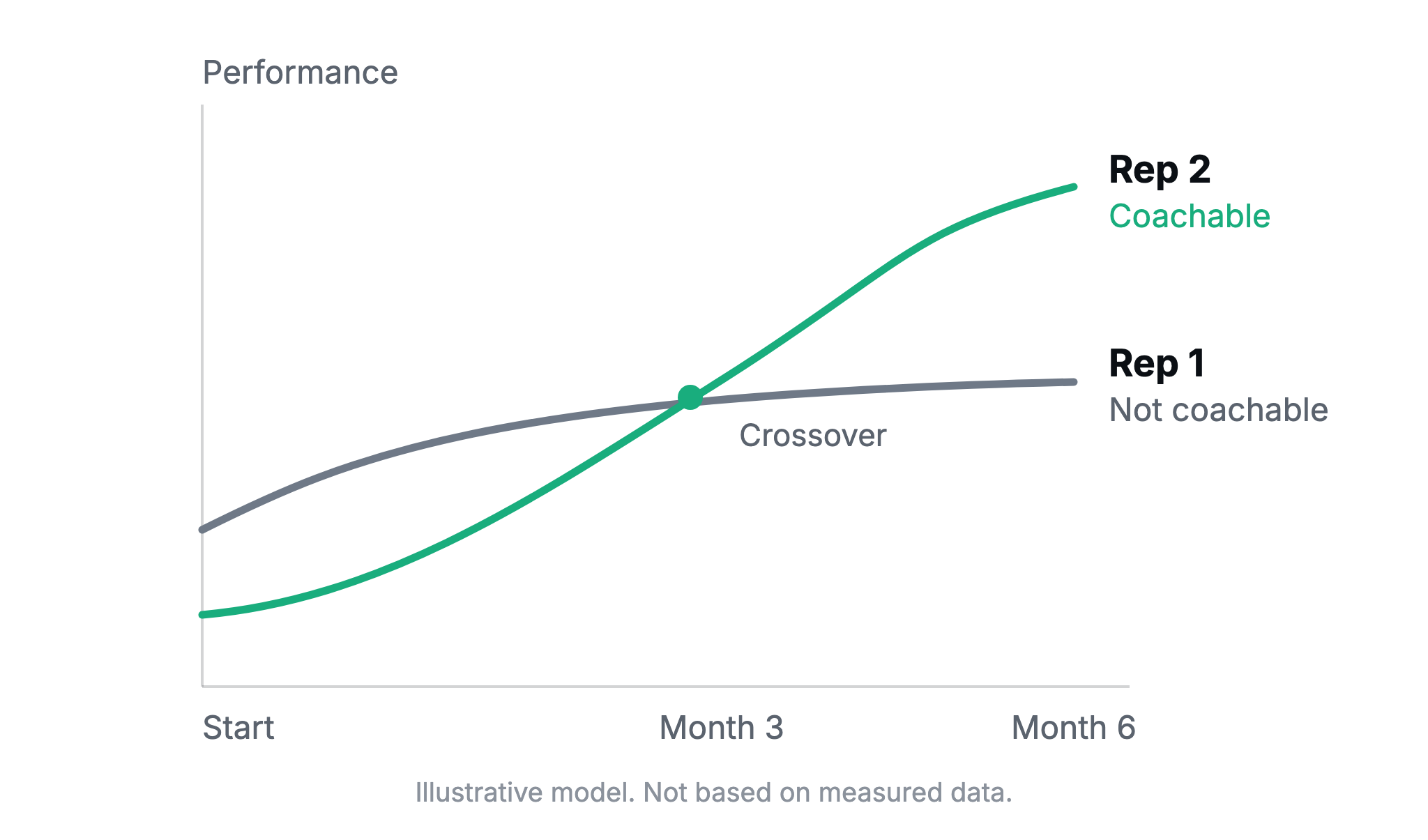
Rep 1 has more grit than anyone on your team. He makes more calls, works more hours, and takes fewer breaks than anybody. His output is consistent and respectable. You can see clearly that a few adjustments to his approach would meaningfully raise his close rate, which would grow company revenue and his own commission at the same time. The problem is that he will not listen. You offer feedback, he nods, and nothing changes. He considers himself too busy to spend time on something that does not feel like immediate activity.
Rep 2 came in with no sales experience, a thin work history, and average communication skills. On paper he was the weaker hire. Three months in, he has started outselling the first rep.
The difference was not talent, hours, or hunger. It was that the second rep took feedback, tried it, kept what worked, and came back for more. Effort compounds only when it is pointed in the right direction, and coaching is what points it.
Coachability Is Not the Same as Agreeableness
This is where a lot of managers get it wrong, and it is worth being precise about, because the mistake costs you good reps.
A coachable rep is not a rep who agrees with everything you say. Some of the most coachable people I have worked with pushed back hard on feedback, argued their reasoning, and then went out and tried it anyway. That is a coachable rep. They are engaging with the substance rather than performing compliance.
The genuinely uncoachable rep often looks cooperative in the conversation. They agree quickly, thank you for the feedback, and change nothing. Agreement is cheap. Behavior change is the only evidence that counts.
So when you evaluate coachability, do not measure how a rep responds in the meeting. Measure what happens in the field over the following two weeks.
How to Screen for Coachability in an Interview
Coachability is hard to detect through standard interview questions because every candidate knows to say they love feedback. You have to test it rather than ask about it.
- Give real feedback during the interview and watch what happens. Run a short role play, then give one specific, genuine piece of criticism. Then run the role play again.
- Watch whether they actually adjust or just acknowledge the note
- Notice whether they get defensive, which is a yellow flag rather than a red one
- The strongest signal is a candidate who asks a clarifying question before trying again
- Ask for a specific time they changed their mind about how to do something. Vague answers here are revealing.
- Look for a concrete before and after, not a general statement about being open-minded
- Ask who gave them the feedback and what their first reaction was
- Candidates who cannot produce a single example usually do not have one
- Ask what they are currently bad at. The answer tells you whether they have an accurate model of themselves.
- Self-aware candidates answer quickly and specifically
- Weak answers name a strength disguised as a weakness
- Follow up by asking what they are doing about it
- Look at their trajectory, not their resume. A candidate who was bad at something and got good at it has already demonstrated the trait you are hiring for.
- Prior industry does not matter nearly as much as visible improvement inside a role
- Athletes, musicians, and military candidates often screen well here because they have lived inside coaching relationships
- Prior sales experience is not automatically an advantage, since some experienced reps arrive with habits they will not give up
How to Develop Coachability in the Reps You Already Have
Coachability is not entirely fixed. A meaningful share of the reps who look uncoachable are actually responding rationally to a coaching environment that does not work.
Make feedback specific enough to act on. “Be more consultative” is not coaching. “Ask about their current provider before you present pricing” is coaching. Reps ignore vague feedback because vague feedback cannot be executed.
Close the loop. If a rep applies your feedback and you never mention it again, you have taught them that applying feedback produces nothing. Come back within the week and acknowledge the change.
Show them the evidence. This is the piece most teams miss. A rep who cannot see that their numbers moved has no reason to believe the coaching worked. When a rep can watch their close rate or their pace change after they make an adjustment, coaching stops being your opinion and becomes something they can verify.
Separate coaching from evaluation. If every feedback conversation feels like a performance review, reps will get defensive, because defensiveness is a reasonable response to a conversation that could cost you your job. Coaching sessions and accountability sessions should feel different.
Why Visibility Makes Coaching Work
Coaching a field sales team has a structural problem. You are not standing next to your reps when the work happens. You see them at the morning meeting and you see the results at the end of the day, and the entire coachable moment happens in the hours in between.
That is why performance visibility is not just a reporting concern. It is a coaching input. When a manager can see which behaviors are trending on which reps, coaching stops being a guess based on the last conversation and becomes a response to what is actually happening.
Enzy gives managers a live view of behavior at the rep level, which means the coaching conversation happens while the pattern is still forming instead of after the month closes. On the rep side, live leaderboards and personal pacing mean a rep can see the effect of an adjustment within days rather than waiting for a commission statement. That feedback loop is what converts a coachable person into a rep who keeps improving, because they are getting confirmation that effort in a new direction produces a result.
What This Means for How You Build a Team
If coachability is the trait that unlocks the others, then two things follow.
First, weigh it heavily in hiring, even at the cost of experience. A coachable rep with no background will pass an experienced rep who has stopped learning, and it usually takes less time than people expect.
Second, build an environment where coaching actually works. Coachability is a two-sided relationship. A coachable rep in an organization with vague feedback, no visibility, and no follow-through will look exactly like an uncoachable one within a quarter.
The advice I would give a rep is the same advice I would give a manager evaluating one. Do not measure yourself by where you currently stand. Measure how quickly you are learning, adapting, and closing the gap between where you are and where you intend to be. That rate of change is the number that predicts everything else.
Book a demo and we will show you how field sales managers use live performance visibility to coach reps while the behavior is still happening.