
The Ultimate Guide to Managing a Field Sales Team
Visibility, isolation and culture: the three problems every field sales manager faces and how to solve them.
 Spencer OuzounianVP of Revenue at Enzy
Managing a field sales team is one of the most demanding jobs in sales leadership. You are responsible for the performance of people you rarely see in person, working in environments you cannot directly observe, facing challenges that vary by territory, day, and individual rep. The conventional playbook for sales management, built around office visibility, daily standups, and real-time floor coaching, does not translate cleanly to a team spread across neighborhoods, cities, or regions.
I built my management approach in the door-to-door industry, which is about as demanding a field sales environment as exists. The lessons from that experience, combined with what I have seen working with sales organizations across multiple verticals at Enzy, inform everything in this guide. My goal is to give you a practical framework for managing a field sales team that works in the real conditions you are operating in, not in an idealized office environment.
The Challenge of Field Sales
Let me explain the Big 3: The three challenges that exist in field sales on a level that you won’t find in a traditional sales environment.
The first challenge is visibility. In an office environment, a manager can walk the floor, overhear conversations, read body language, and get a real-time sense of energy and performance. In field sales, none of that is available. You are managing largely on data and periodic contact, which means your ability to coach and intervene depends heavily on the quality of the information you have access to.
The second challenge is isolation. Field reps spend most of their working hours alone. This is motivationally difficult in a way that office environments are not. The social energy of a high-performing team, the visibility of peers competing, the ambient accountability of others working around you, none of that is present in the field. Reps have to generate their own motivation and discipline, which is a skill that not every rep comes with naturally.
The third challenge is culture. Building a cohesive team culture when your team is physically distributed is genuinely hard. The informal interactions that build trust and team identity in office environments simply do not happen organically when your reps are in different zip codes. Culture in field sales has to be intentionally constructed rather than allowed to develop naturally.
Now I’d like to present the tools and frameworks that help address these challenges of visibility, isolation and culture. If applied correctly, these tools will help you successfully manage the aspects of field sales management that are not solved by traditional sales management tactics.
The Visibility Problem
The starting point is defining the metrics that actually matter for your team and making sure you have reliable, timely access to them. Real-time access to these metrics changes the nature of field sales management. A manager who can see that a rep's activity dropped significantly on a Tuesday afternoon can reach out that same afternoon to understand what happened, whether it was a logistics problem, a motivation problem, or a coaching opportunity. The same manager working from a weekly summary report is always responding to history rather than influencing the present.
Beyond performance data, regular and structured communication routines help compensate for the lack of in-person contact. Short daily check-ins by text or a team communication channel, weekly one-on-ones that are focused on specific data rather than general impressions, and team-wide communication that keeps the broader context visible create a connective tissue that partially substitutes for the ambient contact of an office environment.
The goal is not to monitor your reps. It is to create enough visibility that you can coach effectively and that reps feel connected to the team rather than operating in isolation.
The visibility challenge in field sales is real, but it is also largely solvable with the right approach to data and communication.
Leading Indicators vs Trailing Indicators
I want to share an example of why it is important to look at what we call “leading indicators”. Let’s use an example of two rookie reps, Alex and Baker. 3 weeks into their first summer, each rep has sold 11 accounts. They’re off to an average start, and you want to train them both so they can sell even more. Using “trailing indicators”, you compare their data:
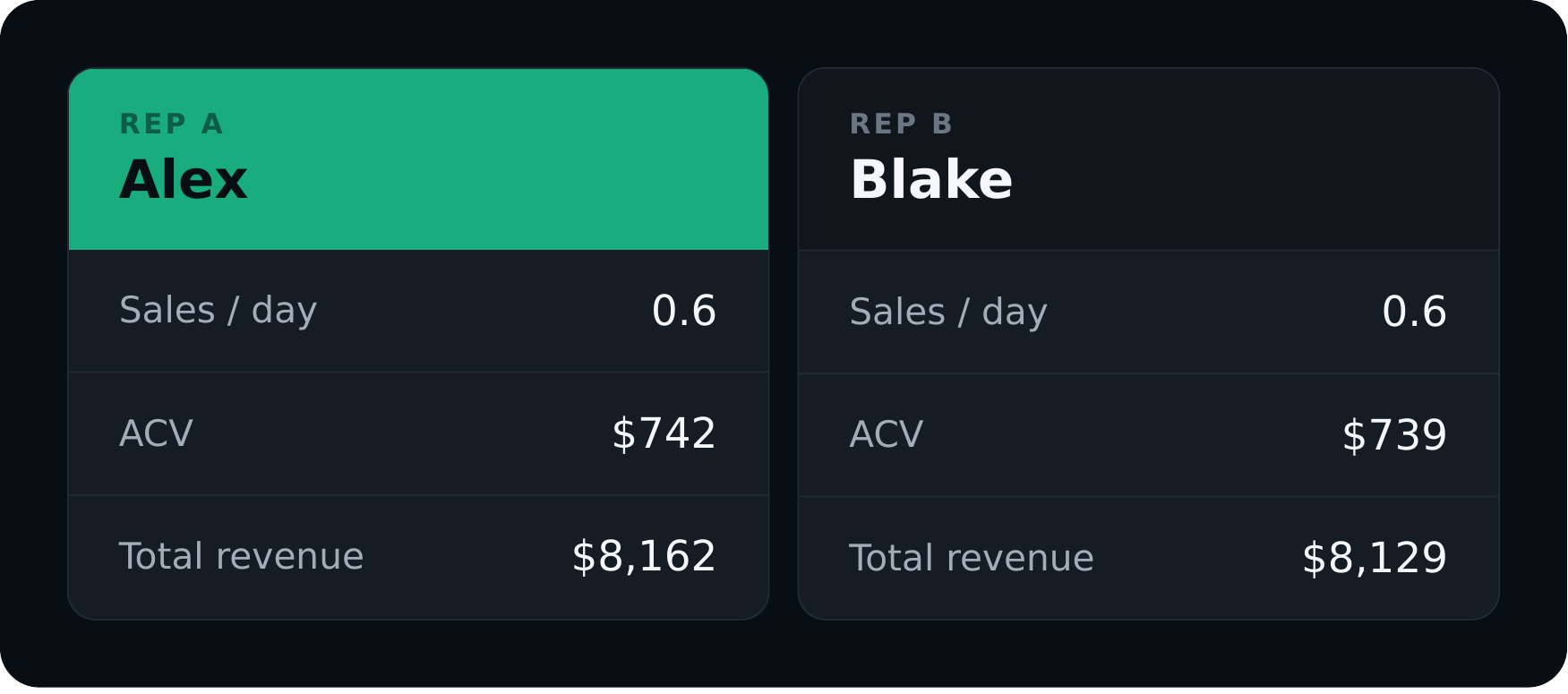
Their numbers are nearly identical. They likely need similar coaching, and are just off to a slow start because D2D sales has a steep learning curve. Maybe you go over their approaches? That seems to be a typical weak point for rookie reps.
After three more weeks, there are small signs of improvement but not a whole lot has changed. Unfortunately, Rep A can’t get into the swing of things and goes home early.
Now let’s look at another scenario. Same reps, both with 11 sales each, but you’re tracking their leading indicators as well.
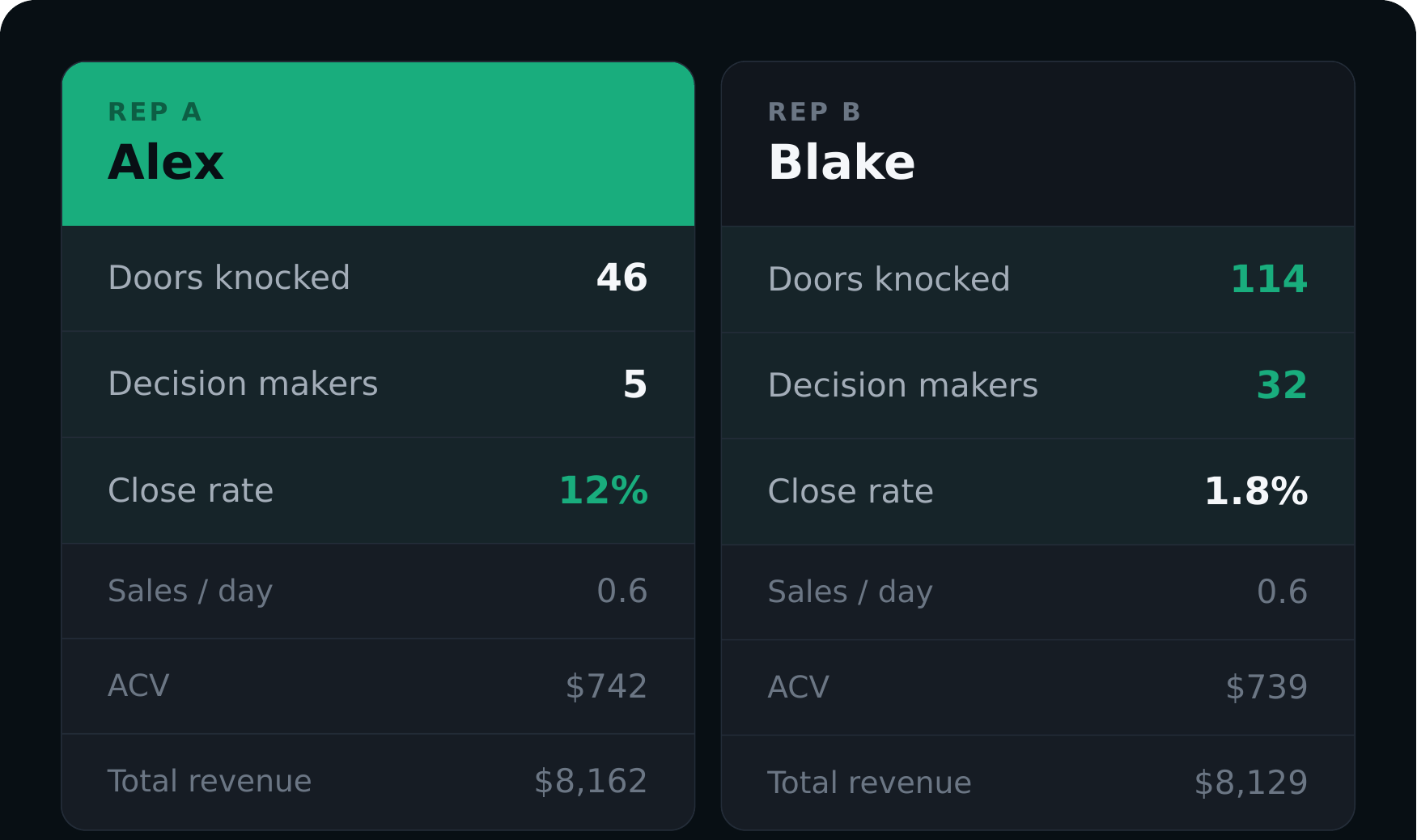
Do you see how these leading indicators change the framing? Now you have the information to train Alex and Blake individually.
Alex is barely leaving his car. He’s sitting on a park bench scrolling reels. 46 doors a day is well below what he needs to be putting up. But when Alex does get up and knock he’s closing at 12%. Well above average for a rookie. He’s a skilled salesman, but his work ethic is lagging behind. If Alex were talking to his 30 decision makers a day, he’d be closing almost 4 sales a day. We’re talking $300k in revenue as a rookie.
Blake, on the other hand, has his work ethic down. The farm raised him right. He's hitting his 100+ doors/day, 30+ decision makers. Unfortunately, he’s not closing nearly at the rate he could be.
By tracking and reporting leading indicators, you as the field sales manager have the tools you need to coach reps individually. You are now in a position to talk to Alex about his motivation and come up with ways to help him knock more doors. You’re also in a position to help Blake close at a higher rate. Both reps will have a better chance at reaching their potential because you are informed with the right data.
Coaching a Team You Rarely See In Person
How would I address isolation? Reps are spread across territories, working independently for most of the day. This is a completely different environment from sales floors where managers get the luxury of boosting morale in a shared setting. You, on the other hand, have to do most of your managing remotely.
This means your coaching conversations need to be anchored in specific, observable metrics rather than general impressions. Instead of asking how things are going, start the conversation with what the data shows: your conversion rate on qualified pitches this week was lower than average. Walk me through what those conversations have been looking like.
That kind of specificity accomplishes two things. It signals to the rep that you are paying attention to their actual performance rather than just checking a box with a weekly call. And it gives the conversation a concrete starting point that makes the coaching more actionable.
For field sales in particular, I also recommend periodic in-person ride-alongs when possible. Even one day in the field with a rep per quarter gives you observational context that no amount of data can fully substitute. You see how they approach a door, how they handle the opening, how they respond to objections. That context makes your data-driven coaching significantly more precise.
When a leader chooses to invest in a rep’s development, and uses specific data to inform that development, that rep has the highest chances of becoming an excellent salesman over a short period of time.
Building Culture When Your Team Is Spread Across Territory
Winning in field sales culture requires leaning on your team to “lift where you stand”. Whatever natural influence your experienced reps have over their own recruits, other reps, or the team as a whole needs to be exercised to its max.
The most effective culture-building tools I have found for distributed teams are public recognition systems, shared performance visibility, and structured team communication. When every rep on the team can see each other's wins being celebrated in real time, a sense of shared identity and collective standard starts to develop even without in-person interaction. The rep in one territory sees that the rep in the next territory just closed a deal and got recognized for it. That visibility creates connection and competitive energy simultaneously.
Structured team communication routines also matter. A daily team message that calls out the previous day's top performers, shares any relevant updates, and sets the tone for the day creates a thread of shared experience for a team that does not share a physical space. It is a small investment with a meaningful cultural return.
Competition is another powerful culture-building mechanism for distributed teams. A well-designed team or individual competition creates shared stakes and shared narrative. Reps who are competing together or against each other have a reason to pay attention to each other's performance. That attention, when channeled through a well-designed system, builds the kind of team identity that keeps reps invested in each other's success and in the team's culture overall.
Conclusion
Managing a field sales team well requires adapting the fundamentals of good sales management to the specific constraints of a distributed, independent-working environment. The core challenges, visibility, isolation, and culture, are real but solvable with the right approach to data, coaching, communication, and technology.
The big 3:
- Visibility Track leading indicators, not just trailing indicators, to understand your reps’ strengths and weaknesses
- Isolation Consistent touchpoints and communication throughout the day sales rep every day
- Building Culture Lead your veterans, and turn them into leaders who can lead their recruits
Built for Field Sales Teams
Enzy is built for the specific challenges of managing high-performance field sales teams. Real-time visibility, mobile-first design, culture-building tools, and performance infrastructure that works whether your team is in the same city or spread across a region. Book a demo to see how field sales managers are using Enzy to solve the visibility, isolation, and culture challenges that make this job hard.